
All of Larry's books and past issues of THE LIGHTNIN' RIDGE OUTDOOR JOURNAL can now be viewed and/or purchased by going to his web site larrydablemont.com. There is also a way to view and/or donate his upcoming book, THE TRUTH ABOUT THE MISSOURI CONSERVATION
Friday, May 29, 2020


Fish Guts
 |
| Carcasses and guts, flies and buzzards... a popular launching ramp that stinks all summer. Corps of Engineers apparently can't do anything about it. |
I believe that we all should give maximum effort to leaving the outdoors and the world around us as natural and as clean as possible. Why are there so many who just don’t seem to give a darn? One of the most disgusting things I have ever seen at an Ozark Lake is at the launching ramp on Truman Lake at a site known as Fairfield. The history of that place is interesting. The lake covered a small, old-days village by that name, a few buildings and a post office. There is a campground and small store north of the boat ramp about a mile. There are several summer homes and likely two-dozen permanent camper-vehicles there and the campground owner has a place to clean fish there.
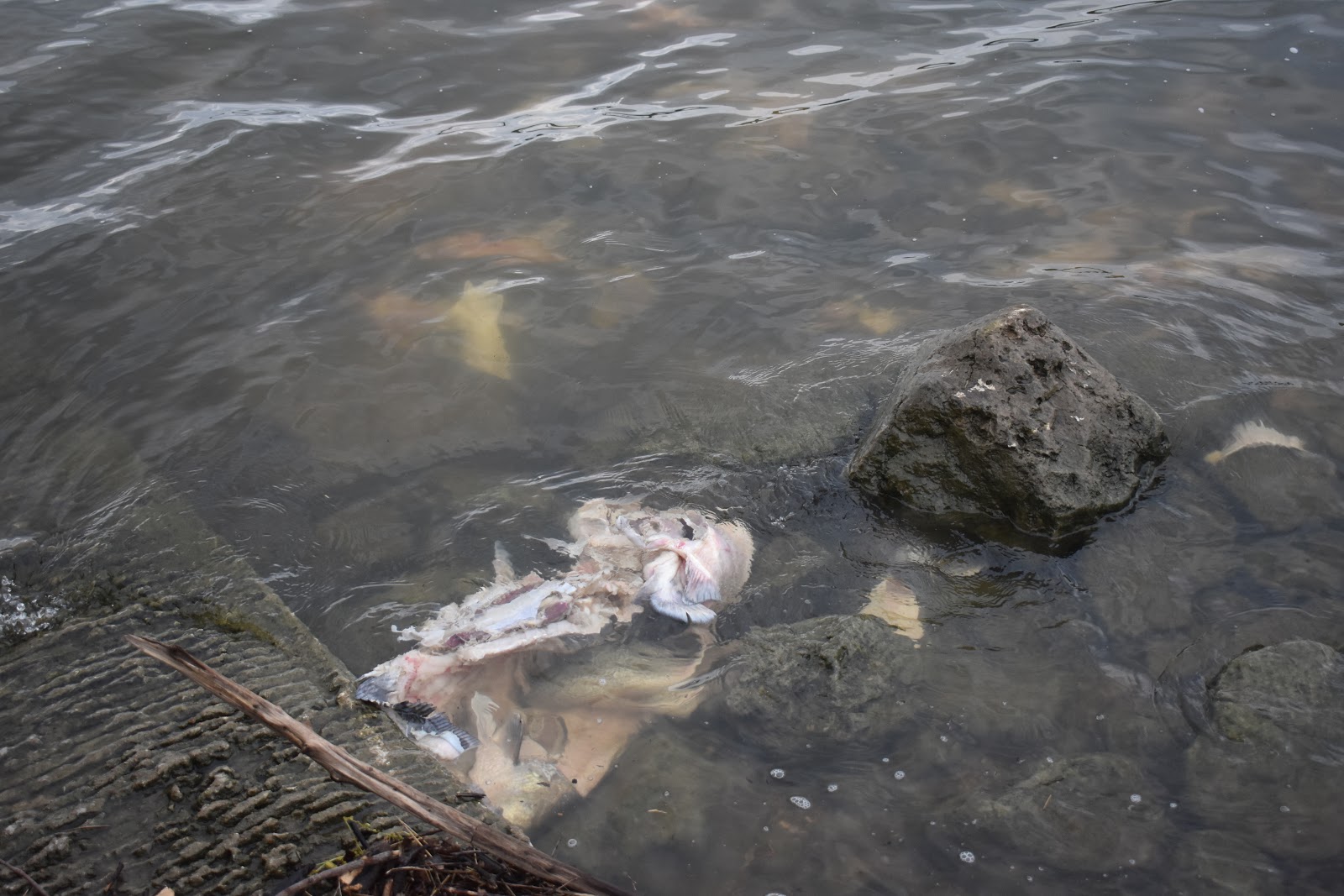 |
| carcasses on top and underneath the water next to launching ramp |

 |
| I could not believe people would actually choose to sit at the dumping site next to the ramp... the smell was horrendous |

The campground owner says he has nothing to do with this, that the dumper who says he does that for him is lying. It would be easy for the Corps to find out who is responsible, who is lying and who isn’t. A retired Corps of Engineers Ranger I once hunted and fished with doubts what I am writing here, saying that one of the Rangers for the Corps says it happens at lots of launching ramps. I am doubting that. I challenge the Corps to show me photos at any ramp that comes anywhere close to that mess at Fairfield. I have been to lots of launching ramps and I do not see that on any scale close to this. Instead of thanking me for pointing out a problem, they’ll be mad at me for this column, like that old friend of mine saying I am basically uninformed. I don’t think they will want to do anything about it, from what I am told, because their offices are many many miles away and the problem is out of sight. Out of their sight…but for hundreds of fishermen who used that ramp over Memorial Day, it was a part of their experience at Truman Lake, and no one should have to put up with it.
While the campground owner denies he knows anything about this, it isn’t something that results from a few fishermen cleaning fish at the ramp. It is a wonder is that there are such people in this world who would do this, whoever it is to blame.
As to the Corps of Engineers, they have a regulation that walking their shore and finding an arrowhead is unlawful. They aren’t going to enforce that, but if you get caught by a Ranger out on the lakeshore with a metal detector and you are going to hear about it. Apparently there is no law against piling up fish carcasses night after night at a Corps boat ramp. What would make them do something to find answers and end the slime and rot and stench at the Fairfield launching ramp? Right now you can stand at the ramp and count 50 or 60 carcasses. They should either erect a sign saying…”Do not dump fish here.” Or maybe… “Do not dump more than 100 fish carcasses and entrails here at one time!”
If this bothers you as much as me… please send this column to the address of any Corps office you can find. First, see the photos I have taken. Go to larrydablemontoutdoors.blogspot.com, or to my website, www.larrydablemont.com.
If you would like to give me heck for writing this, thinking it is no big thing and should just be ignored (as the corps does)… just email lightninridge47@gmail.com or write to me at Box 22, Bolivar, Mo. 65613
Tuesday, May 5, 2020
An Uneventful Turkey Hunt…a Spectacular Turkey
 |
| A seven bearded gobbler |
I
guess in most ways he was an easy gobbler. I can’t say there haven’t been many,
many others that were more of a challenge. From his spurs it was apparent that he was old. But then so
am I. On opening day I was too
sleepy to get out of bed, so I didn’t hear him gobbling on the roost. The night before I had been writing very
late so I was still sleepy when I threw my old shotgun over my shoulder and
headed for the woods after 8 a.m.
I went down through the woods with the sun climbing high and found a few
mushrooms, and then about a half mile away I heard a gobble, and then
another. Even someone who has
hunted wild turkey for 50 years gets excited about hearing an old tom on
opening day. I will always head
for a wild gobbler’s call like a beagle pup on the trail of a rabbit.
When
I got to the little wooded knoll I thought was close enough, I could actually
see two gobblers in a little opening about 200 yards away, courting 5 or 6
hens. What a sight it was, those
toms all huffed up with tails spread and heads blood red in the bright sunlight
that found its way through the branches of surrounding oaks. Well as any grizzled old veteran turkey
hunter knows, there are times when calling a gobbler is a waste of time,
because he can see the hens before him, and one off in the distance that he can
only hear just isn’t of much interest to him. If he has a shapely young female in a bikini right there in
front of him, telling him what a handsome rascal he is and enticing him to come
closer, he sure isn’t going to leave her and go check out a distant call from
some hen that might be old, fat and ugly!
On
a few occasions over the years I have called in a small group of hens, 2 or 3
usually who have been followed by gobblers. That is rare, but it can happen. So I got settled up against a log with some buckbrush before
me and gave forth some of the most enticing turkey calling you can imagine,
apparently sounding like one of those fat and ugly old hens. The show out there before me was
something to see, a turkey flock orgy of sorts that made me plumb ashamed to be
watching. It was about 10 a.m.
when I just gave up and leaned back against that log and dozed off. I didn’t know I was so tired. I woke up about 11: 30. Maybe it was a lusty gobble that woke
me up. The two old toms were about
30 yards closer than they had been
and there wasn’t a hen in sight.
This
is where I might brag on my ability as a turkey caller you know. But I only called once. I doubt if it
had much affect, they were coming straight as a string. They just ambled toward
me, pecking here and there, not strutting at all. At 70 or 80 yards they stopped and gobbled in unison, and if
you’ve hunted spring gobblers I expect you have seen that too, on
occasion. They did that one more
time when they were about 45 yards away.
I couldn’t tell one from the other so I just picked out a red and blue
and white target and it was all over as the shotgun blast interrupted the
peaceful forest landscape.
So
there I was waiting for the gobbler I had chosen to stop flopping, watching his
buddy hotfoot it in a big curve through green grass into a green woodland.
I
had found a few mushrooms, had a good long nap and was heading home before noon
with a hefty gobbler over my shoulder.
I don’t know why I hadn’t paid much attention to the beard, but it was
two hours later, when I hoisted the gobbler in my basement to be dressed out,
that I saw his beard, and another and another and another. THERE WERE SEVEN OF THEM!! The longest was 11 inches long, and the
combined length of all seven beards was 49 inches. The tom weighed 21 pounds and had spurs that were one and a
quarter inches long. You can see
his picture on my blogspot and on Lightnin’
Ridge facebook page, or on my website... www.larrydablemont.com. A friend of mine was amazed at that tom turkey. He said that with the Wild Turkey Federation’s
record book, my gobbler would
likely score in the top five!
That’ll be the day… if I start trying to score a wild turkey, somebody
come and declare me an idiot and have me locked in my storage shed. Never will I use a wild creature in
such a way. I may have it taxidermyized
just to prove it really did have seven beards. But to tell the truth I have had much more exciting
turkey hunts. If you don’t believe
it, read about many of them in my book, ‘The Greatest Wild Gobblers’. In the 80’s I wrote an article for
Outdoor Life magazine entitled, “The Gobbler Across the Gulch.” I reprinted it in that book. Now there was a gobbler to
remember. But he only had one
beard.
Next
week… A spring outdoor quiz for the ‘Master Naturalists” and a story about
fishing in solitude.
Friday, April 24, 2020
That’s Crazy

Next
week, I am going to spend several nights on some lake in my camp-boat and hunt
turkeys. I intend to take a long
my johnboat to use for fishing. I will set a trotline, hunt mushrooms and
arrowheads, and pretty rocks, catch bass etc. I may ignore crappie because I catch all of them I want in
late April and May at night under lights… and white bass and walleye too. Now do any of you have any better plans
than that? It is social distancing
at its best.
Hunting
rocks is a great hobby of mine for which I am often looked upon as crazy. But once when I lived down in Arkansas
I went to Bull Shoals lake and filled up my boat with beautiful rocks and in 3
or 4 trips I had my pickup weighed down with them. Most were only a few inches long but some were larger, up to
10 pounds perhaps. The next day I
packed a suitcase with another shirt and pants and headed for Iowa. If you had seen me with that pickup
sagging in the back you would have said I was crazy then too.
But
the next day I drove to every fish and aquarium shop I could find and sold that
pickup full of rocks for a little better than 800 dollars. It doesn’t sound like much money but in
the early 80’s it wasn’t to be sneezed at. I did the same thing a couple of times in Illinois. Not once
did I bring home a single rock. Aquarim shops went nuts for them. I told them they were imported from
somewhere in Africa. In Harrison, Arkansas I stopped at a local filling station
and the attendant, who knew me, said, “Dablemont, you are Crazy!! So I have gotten use to being called
that.
Today
you could do the same thing on about any Ozark lake, but I found out it is
illegal, so be careful; some Corps Ranger might haul you in for aggravated
rock-stealing. At the same time, I got a permit to take a whole load of dead
cedar poles from Bull Shoals to an Omaha Nebraska landscaper. You wouldn’t believe how much he paid
for them. He was just as crazy as
I was, and the people that paid him for those were even crazier. On Bull Shoals alone there is a million
dollars worth of cedar logs, beautifully white and silver colored, dead since
the 1950’s and some of the prettiest decorative fencing you ever saw. Sounds crazy, but it is true.
Outdoorsmen
are often accused of being crazy.
For instance, what is crazier than setting in some bushes, risking ticks
and copperheads, scraping on a little box with a shotgun in your lap and some
green and black paint smeared from one ear to the other? That fits many hunters and from the
mid-seventies into the nineties, I made a bunch of money taking those crazy people
turkey hunting and camping here and there each spring.
Often,
you will call in a big old wild gobbler and he will start flopping around on
the ground and another one will run to him and start fighting with him. I had to kick one off my dying turkey
once and he kept coming back. I
remember telling some of the guys at the pool hall what I had seen and they
said I was crazy! They said the
same thing when I told them I had called in a gobbler by with a squeaking gate
hinge on my neighbor’s farm. Heck,
when you see a tom turkey trying to escape by sticking his head and neck
through an old hog-wire fence in the woods that he could just jump over, you
realize that turkeys are as crazy as hunters.
I am quite sure that as I roam the woods
this week hunting wild turkeys with a shotgun in one hand and my camera in the
other, I will see some things that will make me think, ‘now that is
crazy’. If I find mushrooms, I
will give most of them away. But
if I find a rock that is something special, I won’t give it to nobody. And if you want to see some of the very
best I have ever found, come up here on Lightnin’ Ridge and you can see them
scattered all over the place and in my office too. I’ve got a dandy on my dresser! I will give away wild turkey meat, mushrooms and fish by the
dozens, but no one can have my rocks.
Sounds crazy doesn’t it. Sometime soon I will write a column about how
to make bass jump in your boat. I
have done it many, many times, but when I write about it readers think I am
crazy.
Well,
this week most of the suburban outdoor writers will be writing about how to
hunt turkeys. But not me, because if you need to read about how to do something
as easy as hunting and killing a wild gobbler, you probably ought to be hunting
rocks instead. Besides that, there
are to many turkey hunters out there, and trying to create more of them seems
crazy to me.
If
you want to read a couple of really good turkey hunting stories, and fishing
stories too, get your hands on one of my spring magazines… The Lightnin’ Ridge
Outdoor Journal, on sale in many stores with magazine racks. Or call my secretary, Ms. Wiggins, at
417-777-5227, and she’ll send you one.
My new website is www.larrydablemont.com and you can write to me at
Box 22, Bolivar, Mo. 65613 or email lightninridge47@gmail.com
Tuesday, April 14, 2020
What Birds is Worthless and What Ones Ain’t
 |
| goose nesting above the river about 20 feet over the water in sycamore tree. |

The
virus hasn’t made life much different for me because how I live now is not much
different than I have always lived.
Up here on this isolated ridgetop I call Lightnin’ Ridge, the highest
point in this county, I have to spend a lot of time watching the birds that
come to Gloria Jean’s bird feeders. It is part of my job because I take it upon
myself to try to shoot all the brown-headed cowbirds I see. I sit there beside my Labrador on my
screened porch, which is up about 6 feet off the ground, looking out into the
branches of oaks, hickories and walnuts wondering when the orioles will get
here, or what kind of wren that little bird on the ground might be. But in almost 30 years of that, I have
never seen wood ducks there before.
About
two weeks ago, a hen wood duck lit on one of the big limbs about ten yards away
from my rockin’ chair. In short
order a beautiful drake joined her.
In a minute or so they flew into another tree, then another and then
another. It went on for 20 minutes
or so, as they moved just north of my office to the pond I built there about 25
years ago. In the fall, groups of
wood ducks have used that pond, but none have ever nested nearby that I can
remember. Those two were indeed
looking for a hollow tree to nest in.
Every time they moved to another tree the drake was just a
follower. The hen was the one
doing the searching. She had an
eye on that pond, perhaps because there is corn spread along the shore quite
often. Dozens of doves feed there
at times, and my place is a haven for nesting doves. I have seen doves nest on
large tree limbs, in head-high bushes and on the ground in thickets.
Hordes
of squirrels start using the hollow trees on my place in February to bring off
their litters and three species of owls nest in them as well; the little ones,
the medium ones and the big ones.
You know what species of owls I am talking about it if you are a
woodsman or an ornithological enthusiast
(bird lover). Too danged
many raccoons have dens for their young on my tract of woodland, and there are
pileated woodpeckers, flying squirrels and honeybees in other hollowed out
trees. Most of those cavities used
as nurseries are in trees that are alive, not dead. There are lots of them, but I sure hope the wood duck hen
found one she likes. If she did, I
think there will be some little baby woodies on my pond soon.
Here’s
a question some of you who have earned your master naturalist certificates in
recent years. True or False…
Woodies can and do raise broods two or three miles from water! True or False… They are the only
waterfowl in the Ozarks that will nest in a hollow tree! Then answer this one…
baby wood ducks leave the nest shortly after hatching. That makes them which of the following…
altricial or precocial. While you
are at it, name those three owl species which nest on my ridgetop. And why would a lifetime professional
naturalist ( I wrote that
‘professional’ with in a humorous vein), kill a brown headed cowbird? Answers later in this column.
I
shot a big old black snake yesterday only a short distance down one of my
trails. He was between 7 feet and
20 feet long! I only shoot black
snakes, copperheads and the occasional water snake in my pond. Please keep that between us because it
is illegal, according to our conservation department, to kill any snake or
anything else that they do not mention in their rules booklet. On a Lebanon radio station a game
warden always ended his program with the words, “Remember, if we don’t say you
can… you can’t”

But
black snakes, which can slither into any nesting cavity and climb any tree, eat
bird eggs and kill baby birds by the dozens, in the spring, and baby
rabbits. My naturalist daughter
Christy, who is a science and biology teacher, says that black snakes are
valuable mouse eaters, to which I reply that I own enough mouse traps to kill
every mouse between my sheds and hers without the help from black snakes. Besides, a white-footed deer mouse is
not anything like a house mouse and should be considered native wildlife. They
are important food to owls and other predators that don’t eat bird eggs and
baby rabbits! If you are someone
who falls into the class of tree-hugger or fern-feeler (non-professional would-be naturalists)
and you like snakes, I will bring you some of the three I named above.
As
to the questions above… altricial birds are those which have to take care of,
and feed their young after hatching.
Precocial birds have fledglings which immediately leave the nests and
feed themselves. When I was young, I was precocial! The three owls are…
little—screech owls. Medium—barred
owls. Large—Great Horned Owls.
Brown headed cowbirds kick out eggs in another bird nest and lay their
eggs in that nest. They are a
parasitic bird known to have done their evil work to more than 200 species of
birds. And lastly, woodies have
been know to nest in hollow trees 3 or 4 miles from water, and hooded
mergansers also nest in hollow trees near water. So do some Canada geese, high in hollow trees right over the
water. Many won’t believe that but
I have photos.
Write to me at
Box 22, Bolivar, mo or email me at lightninridge47@gmail.com My website, where you can see and order
one or more of my 10 books or issues of my outdoor magazine, is found on the
computer at www.larrydablemont.com.
Sunday, April 12, 2020
Another kind of Hunting

It
is ‘mushroom’ week here in my area of the Ozarks. I found the first ones on the second day of April, which is
unusual because the average time of eruption over the years has been about 10
to14 days into the month. I have
what I call an ‘indicator tree’.
It is a big ash tree on my place where the very first mushrooms appear
each spring, and over a two-week period in past years it has produced from 20
to 35 mushrooms.

I
found three there a few days back and I know that it will have more. Then about a week later there will be
mushrooms sprouting up on Truman Lake, about 30 miles north of me as the crow
flies. A week or so later there
will be mushrooms to find in north Missouri.
Folks
get excited about finding extremely large morels. I have found one about 12 inches tall with a diameter of
nearly 4 inches. BUT… I am
usually in southern Canada on some lake that first week of June, and there,
when you find morels, they AVERAGE 10 or 12 inches. I have found morels there that were 15 inches tall. I never look for them in Canada; you
just find them along the lakeshore here and there. Some years though you never see one. But when they are there, they are very
big.
I recommend that if you have never found
morel mushrooms, you begin looking for them around very large ash trees. Ash trees send out long large roots
which may curve around as far as 15-feet from the trunk. The tops of those
roots stick up out of the ground.
Mushrooms grow up all around those roots. But over the years I have found morels in cedar groves where
larger cedars grow, around big sycamores along waterways, around open areas
where May apples bloom, under dogwoods, and… well heck, I have found them in
what we jokingly refer to as a ‘lawn’ around my house up here on Lightnin’
Ridge.
They
grow where nature puts them. Along
small streams I have found them on gravel bars and on a sand bar beneath maple
trees. Those sandbar morels are
worthless because there are tiny grains of sand all throughout the indentions
and actually inside the meaty part of the mushroom, and you cannot get them out. When you fry them and bite into one,
you are chewing on grains of sand.
The
funny thing about finding morels a little early this spring is that everything
that blooms is blooming a little later than usual. But I am not just going to look for and eat mushrooms around
my wooded ridgetop in April. I
will fry up some pokeweed leaves, (only the young small ones) and some cow
pasley (parsley to educated folks) lamb’s quarter and crows foot, and make some
sweetened sassafras tea out of the roots of small sassafras saplings. If you
want to try those plants, look them up on a computer or in a book so you can
identify them and learn how to eat them.
If you get ahold of hemlock, which is similar, it can kill you!
Later
in the summer there will be raspberries, and blackberries and mulberries up
here within a hundred yards of my home and office, and then in the fall,
persimmons, pawpaws, walnuts, and more mushrooms of one type or another. I built a pond twenty-five years ago to
water ridge-top wildlife and it is full of fish and bullfrogs. All around me there are squirrels,
rabbits, quail, turkey and deer.
If the time comes that city supermarkets don’t open or they don’t have
food, the natural market allowing survival is right outside the door. Many country people can say the same
thing.
This
week I will eat fried mushrooms until I get sick of them. And I will give away a bunch as well. If you want to come and hunt them with
me you can, as long as you wear a mask and raincoat and stay 10 feet from me!
I
might mention that in May and June, when those orange day-lillies are blooming
everywhere, that if you collect a bunch of the buds before they bloom, you can
roll them in egg and flour and fry them like mushrooms. Great eating! They are known by country folks as ‘poor man’s asparagus’.
Which means, I guess, that you can fix them like you fix asparagus. I ain’t never done that… but I may try
it this summer.

I
want to caution prospective mushroom hunters that there is a large rusty-red
mushroom known as beef-steak mushrooms that are often found even earlier than
morels, and many people slice them and fry them too. They may be found as big as a basketball and even
bigger. But while some folks eat
them with no problem, others get very sick from them. I don’t know why.
But heck, there are some folks who get sick from eating too many morels,
so if you are a first time
mushroom hunter, do this… eat only a small amount of either at first. Find out if you have a mushroom
tolerant system.

Beefsteak mushroom
Beefsteak mushroom
at a distance
Some
folks is different than us normal folks, I’ve heered. I once knew an old boy at the pool hall that got sick ever’time
he ate baked ‘possums and another feller who was allergic to peekans and
walnuts!!
Wednesday, April 1, 2020
Doggone White Bass

Dablemont column 3/30/20
White
bass caught on ultra-lite equipment, will outfight about anything in a stream…
except smallmouth. And when there is a good current in a tributary to any Ozark
lake, if you find a bunch of those big female white bass, you can wear yourself
out just trying to get a dozen or so in the boat.
That
awful experience reared its ugly head for a friend and I a couple of days
ago. We were up in a rain-swollen
river trying to hook a walleye or two and big hefty female white bass kept
intercepting our multi-colored crank baits. Sometimes we just struggled to get
them back to the boat.
We
might have caught a nice walleye or two or even a lunker smallmouth if they had
just let those lures alone, but they wouldn’t. We’d feel a hard jolt out several yards into the current and
the drag would screech for a minute or two and some big ol’ egg-laden white
bass would bend a rod nearly double, whilst we would hang on and hope they
would tire a little. What a fight!
Finally
we just gave up and caught a whole passel of them out of spite. That can be a
lot of fun if you wouldn’t druther catch a walleye. White bass are below those
shoals of many lake tributaries wanting to spawn soon. You would think any fish wanting to
spawn would be less interested in eating, but now that I think about it, I have
known a few pregnant women who just couldn’t get enough to eat, so it may be a
natural thing amongst females.

You
might keep that to yourself or in the spring when you are out fishing for white
bass you may find two or three boats congregating next to any sand bars. I don’t fish on weekends, because of
that problem. Weekends in the
spring, everyone, goes fishing.
For example, last Saturday afternoon I motored up one river to look for
some mushrooms and shed antlers and the place was all choked up with
boats. I saw one 17-foot boat with
three kids and four adults in it and fishing rods sticking up everywhere like
quills on a porcupine… probably looking for my favorite sand bar.
I
passed one small boat with a father and a boy about 10 or 11 and my mind went
back to my own boyhood, when I spent hours in an old wooden johnboat with my
dad or my grandfather, floating the Big Piney when almost no one did but
us. I couldn’t believe how much
that young boy looked like I did at that age. Discarding my usual contempt for city folks who flock to the
Ozarks on weekends, I couldn’t forget the look on that little boys face as he
clutched that rod and reel.
So
I motored over and told them if they would follow me I would show them my
secret sand bar. I got my picture
took with that youngster, and found out that his father, from Kansas City, had
been reading my fishing book the week before they came down to fish. Well, for some reason the white bass
weren’t hungry that afternoon, but they said they would keep my favorite spot a
secret and would only fish there when I wasn’t. I hope they come back sometime. I would like to see that little boy haul in a stringer full
of those whites. I cannot get that
blond mop of hair and his “I want to catch a fish” face out of my mind.
I’ll
share another secret with all you readers. I do not like to eat fish! I guess eating so many as a boy has sorta made me allergic
to the taste. I don’t like any
fish, not even crappie or walleye.
But
I filet what I catch and try to give them to poor or elderly folks who just
love them. Chances are you will
like white bass, hybrids or stripers if you learn to skim off the red
meat. It is a little like skimming
the chocolate icing off a cupcake, but it leaves a red stripe down the center
of the filet you have to eliminate also.
I think that this week I will put photos of that step-by- step process
on my website, www.larrydablemont.com. That
way, many will change their attitude about eating white bass filets. I will add
some of my recent photos and what I promised to post about paddlefish.
Let
me add this… if you are a landowner instructed to register your land with the
MDC so you can get a landowner permit this spring to hunt wild turkeys, DON”T
DO IT! There is more to this than
you know. I will hunt my land
without the permit. It will be the
first time I have ever intentionally broken the law, but there isn’t a
conservation agent anywhere who will be able to catch me. Makes me feel like
one of them Bostonians who threw the tea in the Atlantic back in the 1770’s.
Write
to me at Box 22, Bolivar, Mo 65613 or email lightninridge47@gmail.com
Subscribe to:
Posts (Atom)