Wednesday, May 31, 2023

A Drama in the Woods


This black vulture is migrating north, coming into the ozarks in large numbers.  Landowners will learn what a terrible interloper he is, and what a plague he is on our land.  You should kill everyone you see if possible.


   I was just in the right place at the right time to see it, and it didn’t last long.  A hawk came out of the timber and passed across a small opening in the woods with a cluster of oak leaves in his talons, pursued by four or five screeching small birds.


   I watched the hawk so closely I didn’t pay much attention to the smaller birds. He flew across a little opening with those birds all over him, just screeching and diving at him with a vengeance. Then they all disappeared into the brush on the other side of the opening, where the drama continued out of sight.


   It wasn’t the leaves in his talons the smaller birds were so incensed about; it was what was also in them.  The hawk obviously had snatched a young bird from a limb, and took the whole nest in his hasty attack.  A tragic story, if you look at it from the standpoint of a mother bird. But if you were the hawk, it wouldn’t seem so awful. Maybe the hawk was feeding its own young with the fledgling it found.


         In this day and age, you’d find the hawk thought of as a villain, with great sympathy for the weaker prey, regardless of what it was.... a rabbit, a young bird or squirrel. The sight of a two-week-old hawk fledgling being eaten by a fox would reverse everything.  Then the hawk, losing her baby to the rotten old fox, would be looked upon with sympathy.


         It is how it is; there is no good or bad in nature, and it never changes.  That is a hard thing for many to accept. I remember when my daughters were little girls; how I tried to explain nature to them, and yet, protect them from the harshness of it. We’d be on a trip somewhere, and one of my girls would notice a dead rabbit in the road.  They’d ask their mother if it was a baby rabbit, or a mama rabbit and she’d tell them ‘no, it was just a bad ol’ daddy rabbit’. That seemed to help.  If it was a ‘bad old daddy’ as it soon became every time they saw an animal dead on the highway, it wasn’t quite as sad as if it were a mama or a baby. 


         I even learned to help.  I would point out that the dead raccoon on the highway had probably just staggered out of the pool hall half drunk and had been chasing a little helpless bullfrog across the highway when a semi nailed him. That way it sounded like he had it coming and the girls wouldn’t be so sad.


   In time, when they grew old enough, I took it upon myself to explain to them that among wild animals, things were far different than with humans.  I told them how the hawk would only have two or three young ones in a year, or perhaps over two years, while a mother rabbit might have as many as 100, and couldn’t even name all of them.


   God had it figured out so both would survive as a species. One species was given reproductive potential and the other given biotic potential.  In other words, if a species had great survival chances, it lived longer and didn’t need to produce lots of young. If a species individuals didn’t survive long, like the rabbit, then the creator gave it the ability to produce many many offspring.


    It is almost beyond understanding, even when you have seen as much, and learned as much as I have in my life of studying and experiencing the outdoors. I still hate to see a fawn drug down by a bobcat, and hear him bleating a plea for survival, knowing his fate is to feed her and a litter of wild kittens somewhere beneath the root wad of a fallen tree.  I wish to heavens that the old cat would just feed them woodrats.  But shucks, a mother rat does not look at her young as being any less wonderful than a fawn.  Only us humans do that.


   I can live with what I have seen in the wild, knowing there are all those surviving fawns which will become little more than grown fender-benders someday, or subjects of a photo for some grinning antler hunter who comes to the woods one week a year with a high-powered rifle.


   For me though, it is even more difficult to understand what mankind is becoming. Many times in the woods, I have felt the Creator with me while I watched His work go on before me. There is no natural change there, and no ‘diversity and inclusion’.


    In the woods there is no gray area, it is all black and white. It isn’t that way in the mess in which men have created.  How have so few convinced so many to embrace a path to oblivion? No right… no wrong!


   In those woods that remain as God made them, becoming harder to find as each year passes, new species coming into the Ozarks never make things better. The armadillo and the black vulture prove that. But the native wild creatures, remain exactly what they were a thousand years ago. It is a lesson men should learn from nature, but will not. If God did create the earth, why didn’t he make diversity among men a reality then???  He didn’t... Think about that.  In the meantime, I will leave what is coming to God.  In the woods, I won’t shoot the hawk that catches a rabbit, but I am going to shoot every black vulture and armadillo I come across!


Tuesday, May 23, 2023

The Bird With a Dagger for a Beak


(Great?) Blue Heron posing for my camera

      What I am fixin’ to tell you now about a fascinating bird, is not what I learned from the ornithology professors in college and what they taught about the great blue heron, it is from what I learned as a boy guiding float-fishermen down the Big Piney, and sitting on the front bench of our pool hall, listening to old-timers who seemed to have very little use for that bird.


      “It was Ol’ Bill who noticed there were getting to be a lot of great blue herons on the river.  He didn’t call them that, of course, he and everyone else called them ‘cranes’!  When the Big Piney rivermen, which included my Grandpa, referred to them, they usually always said ‘them damn cranes’.  They didn’t like the herons much.  For one thing, they looked at them as fish eaters, and they didn’t give anything back to the hill people because they were not ‘fit to eat’.  Many of the front bench regulars had tried them and never tried to eat one more than once.  My grandpa said they were of dark meat, and about like trying to eat a merganser.  Of course if you never tried to eat a merganser, then that wouldn’t mean much to you. 


      Serious talk in the pool hall reflected on the fact that the great blue heron was a fish eater, as were all the folks in Big Piney country.  Herons ate all the fish they could spear with that dagger-like beak.


      Ol’ Bill said he had seen one with a ten-inch goggle-eye in its beak, and Ol’ Jim decided to go him one better.  He said he had seen one standing in the water on a shoal with a two-pound smallmouth in his mouth, holdin’ down a bigger one in the water with his foot.


      I always realized that a heron could inflict very severe wounds with that strong dagger-like beak. Perhaps that is why a bobcat or coyote avoids them. I recall finding one caught on a limb-line many years ago and getting out my knife and going in close enough to free him.  I might have been in serious danger.  He looked at me menacingly with no regard to the fact I had likely saved him from an awful death.


      Anyways, most outdoor writers will tell you stuff you can easily find in books, like how many eggs a blue heron lays and how he is an alternate host to those little yellow worms in smallmouth bass. Yellow grubs they call them… look that up on the Internet if you want.  What it amounts to is, those little pennywinkle snails in the river and the bass and the herons of all species, are the trio which hosts different stages of that grub that you see in the meat of bass on all Ozark streams.  And you might find all sorts of info on great blue herons in various bird books.  But you won’t hear many outdoor writers tell you about how they would have killed twenty or so of them one time if had he had a gun. I would’ve! 


      It was a while back and I had floated down the Niangua River to camp overnight on a gravel bar beside a big eddy where I set a trotline expecting to land a big flathead catfish sometime during the night.  You need to realize that blue herons love to build ‘rookeries’ in huge sycamores, and a rookery amounts to 12 or 15 or more nests in one tree.


      Years back blue herons only nested down south in Arkansas and Louisiana swamp country but in time, likely only about 25 years ago, they started building those rookeries in the Ozarks.  That night on the Niangua, I set my tent just upstream from a summer rookery.  If you have never seen one, a heron rookery has one or two adult birds for every nest, and they are always loudly clucking and screeching all night long like herons do.


        They do that in hot weather when they are incubating eggs or the nests have little ones.  Do you know why they do that? Neither do I and neither does anyone else.  They are loud, and fifteen or twenty of them in one big sycamore means you have a hard time sleeping.  That night I thought they would stop the racket and go to sleep, but they didn’t.


      I just stayed up all night and did in fact land a big 30 pound flathead about two in the morning while the herons cackled away.  It was the only good thing I could say about that night!  In my experiences on the river as a kid and in years since I cannot think of any thing concerning the blue heron that would make me want to brag on them. 


      They are very, very overpopulated and eat lots of bullfrogs!  If they ate just only fish I could handle that, but I have little regard for anything that eats my bullfrogs. But then, they afford opportunities for photographs among novice river floaters who keep their cameras dry, like no other living thing on the river.  That is about the best thing I can say about a blue heron. Any amateur photographer can get dozens of photos of herons, turtles and geese.


      In writing about them, I refuse from now on to call them ‘Great’ blue herons!  Except for their size, there is certainly nothing great about them!


You can see back issues of my magazines or my books on www.larrydablemont.com, but if you have missed some of my columns in local newspapers, see them on 

www.larrydablemontoutdoors.  This week I will put some photos of blue herons on that website.


Monday, May 15, 2023

A Not-So-Bad Invader


       A collared dove came up to visit Lightnin’ Ridge yesterday.  My wooded ridgetop is of little interest to him as far as a nesting site.  Mourning doves fly up here and feed on bird-feeder seed that is scattered on the  ground.


    There is a farm down the road where the visitor and his mate nest and spend most of their time, but on occasion both come here for a short time.  They are found around farm-steads and barns all around the Ozarks, sort of like their cousins, the pigeon.  


       But pigeons dwell in large flocks and collared doves do not, at least here in the Ozarks.  And unlike the mourning doves and pigeons, the collared doves clear out during the winter, migrating south.  I am told they are thick as flies in the southwest and hunted there, particularly in Texas and west Oklahoma and further west.


       In some of those states, including California, there is no limit on them and no season restriction.  That is because of how common they have become there, and the fact that they are known as an ‘invasive species’.  They are an Asian bird that moved into Europe over a period of time more than 100 years ago.  Then a bunch of them were brought into captivity in the Bahamas, and escaped during a hurricane about 1970.  The group of less than two-dozen ended up in Florida and just exploded in population. 


       I suppose where they are the most numerous, they are the closest we have come to what was the extinct passenger pigeon.  Now they are found in growing numbers in California and up into Oregon and Washington.  Dumb   birds, why would anything want to go to one of those states?!!!   Well, smarter individuals are also moving into southern areas of Canada’s western provinces.


       The ones that visit me are about 20 percent larger than my mourning doves and much lighter, a buff color more than gray.  And they have that distinctive black collar on the neck. It is said they are a little better flavored than mourning doves, and easier for a hunter to hit.  ‘Invasive species’ designation makes it sound as if they are a problem, but I can’t see how they cause any difficulty in the Ozarks. 


       I have never seen any while dove hunting in the fall.  They can produce up to 8 or 10 young per summer because just like other doves, they lay 2 eggs at a time several times a year from February into September. 


       Another invasive critter up here on Lightnin’ Ridge is the gray squirrel.  They invade all our bird feeders!  And amongst them is the darndest thing I have ever seen…  a gray squirrel, (Sciurus carolinensis) which is colored totally like a fox squirrel, though more blonde than red.  I have seen white and black gray squirrels but never a blonde one.  


       You can also see details of my plans there to renew the old “Common Sense Conservation” organization.  Twenty years ago that group united to oppose the Missouri Department of Conservation’s plan to take away landowner permits, and was successful in stopping it. Other progress was made when the group worked with Enforcement Chief Larry Yamnitz to curtail some agent abuse in the Ozarks.


        I want to get 250 new members to stand up for common sense changes in the way things are done in what is, in my opinion, a very corrupt and wasteful state agency.  


        I have 5 very important objectives which I will put forth, and I think it is time for those of you who contact me with concerns about the MDC’s  directions to meet with me and help form this group. Complaining doesn’t work; actions we can take will indeed work. Our first meeting will be at Buffalo, Missouri on Sunday afternoon, July 16 at a big restaurant with a meeting room.  It is known as Jem’s restaurant.


       We will then follow up with meetings in Houston, Owensville, Steelville, Lamar, El Dorado Springs, Joplin and perhaps one or two other towns in the state, in August and September.  Please read the details of this plan on that website above, or contact me to get a flier about our group to put up in your area. Again, if we can get 250 members before the fall, the MDC might listen to some ‘common sense’ again. 


       You can reach me at Box 22, Bolivar, Mo, 65613 or email lightninridge47@gmail.com  You can call me at my office, 417-777-5227 if  you want to become a leader in this organization.  This is important and I need a dozen devoted leaders to make it work.  Lets do it!!


Tuesday, May 9, 2023

Lunkers Under the Lights


Threadfin shad circling the boat on Bull Shoals Lake


Night fishing under submerged lights has supplied me with some great fishing memories and stories.  I thought the other day about the great fishing Bull Shoals Lake had produced back when I lived in North Arkansas and my Uncle Norten was still alive, many years ago. 


There was one fish in particular!  We had fished most of the night, and by 7:00 a.m. I was bone tired.  It was daylight, but the submerged lights on either side of the pontoon boat were yet burning, and threadfin shad were still circling by the thousands, their masses making a slight whirring, rustling sound in the water around us. The shad nets were so full of shad you could barely lift them out of the water.  We had limits of crappie and walleye and a number of big white bass.


       I hooked one of the thread-fin shad onto a quarter ounce jig-head I had just tied on, and cast it out away from the boat toward the steep rock bank about thirty feet away.  Immediately a fish took it. I set the hook, and the fight was so-so, even though I could see in the clear water that it was a pretty good bass.  In fact it weighed a little better than five pounds by my best estimation, even though it fought like a bass half that size.


       Examining the fish, I could see why.  Apparently it had been injured at one time or another, seriously enough that one side of its body was stiff and inflexible, like it was made from a hard Styrofoam.  I called Uncle Norten over to look at it, even though he had just landed a nice walleye and was much more interested in it than my rather ordinary bass.


       And then he too was amazed.  “Never seen nothin’ like it,” he told me.  “That bass is stiff as a board.  Wonder how he swum like that?” And that’s when I said it…”Yeah, he’s been injured and those muscles on one side have ‘atrophied’..it’s a wonder he has been able to survive.”  


       A day or so later, drinking coffee in a small Ozark cafĂ© just after sunrise, he told his buddies that on a fishing trip just a couple of nights before his nephew had caught a “petrified bass” of better than five pounds, twenty inches long and hard as a board. That was a story even they couldn’t believe! He had them looking at each other with winks and nods that had him a little miffed. ‘If he said we had caught a petrified bass, they ought to believe him’, he figured.         I bailed him out by coming along a day later and putting an end to the snickers and winks.  Uncle Norten hadn’t exactly lied.  The fish was atrophied, not petrified.  And while they accepted what I said, they weren’t real sure what the difference was either. My uncle wasn’t actually lying; it was just a matter of choosing the wrong word!


       We are at the prime time for night fishing beneath the lights.  On Bull Shoals the best of it will be the period of total darkness in late May after the moon is gone.  You find a good place off the main lake channel, along a bluff somewhere and put out submerged lights, and wait for the threadfin shad to move in.  There is no better place or method to catch a giant walleye than on Bull Shoals or Norfork in early summer beneath submerged lights.      


    My biggest walleye there on Bull Shoals was eleven pounds, but I was with a fisherman who caught a sixteen-pounder one early morning back in the late 70’s.  But in more recent years, there have been many four- to six-pound walleye taken from my boat on Bull Shoals beneath the lights in May, sometimes as many as ten or 12 per night.  And the crappie there are huge, commonly thirteen- or fourteen-inches in length, and often up to sixteen-inches.  On Bull Shoals under the lights, three- to four-pound white bass are often taken, and once in the early 80’s a Nebraska client of mine took a five-pound, four-ounce white, just a few ounces under a lake record. 


       Night fishing beneath the lights on Stockton Lake in Missouri lasts through much of the spring and it too is spectacular at times.  Just last week I went out on a 45-degree night when the moon was full.  Because of the bright moon and cold, I didn’t expect much, but between 10:00 p.m. and 1:00 a.m. I caught a limit of twelve- to fourteen-inch crappie and nine big whites up to fifteen-inches.  None had spawned, neither crappie nor white bass. 


       We’ll fish there with submerged lights again this week. On Stockton there are no threadfin shad, so you have to take minnows, or fish with white jigs or spoons, or white pork-rind.  But there are plenty of nice walleye on Stockton too, though not quite as many nor as big as we find on Bull Shoals.

Write to me at Box 22, Bolivar, Mo. 65613 or e-mail me at lightninridge47@gmail.com


       Our new spring magazine is out. Full color, 112 pages about the outdoors and the Ozarks.  If you want to get a copy, call me at 417 777 5227.    


Wednesday, May 3, 2023

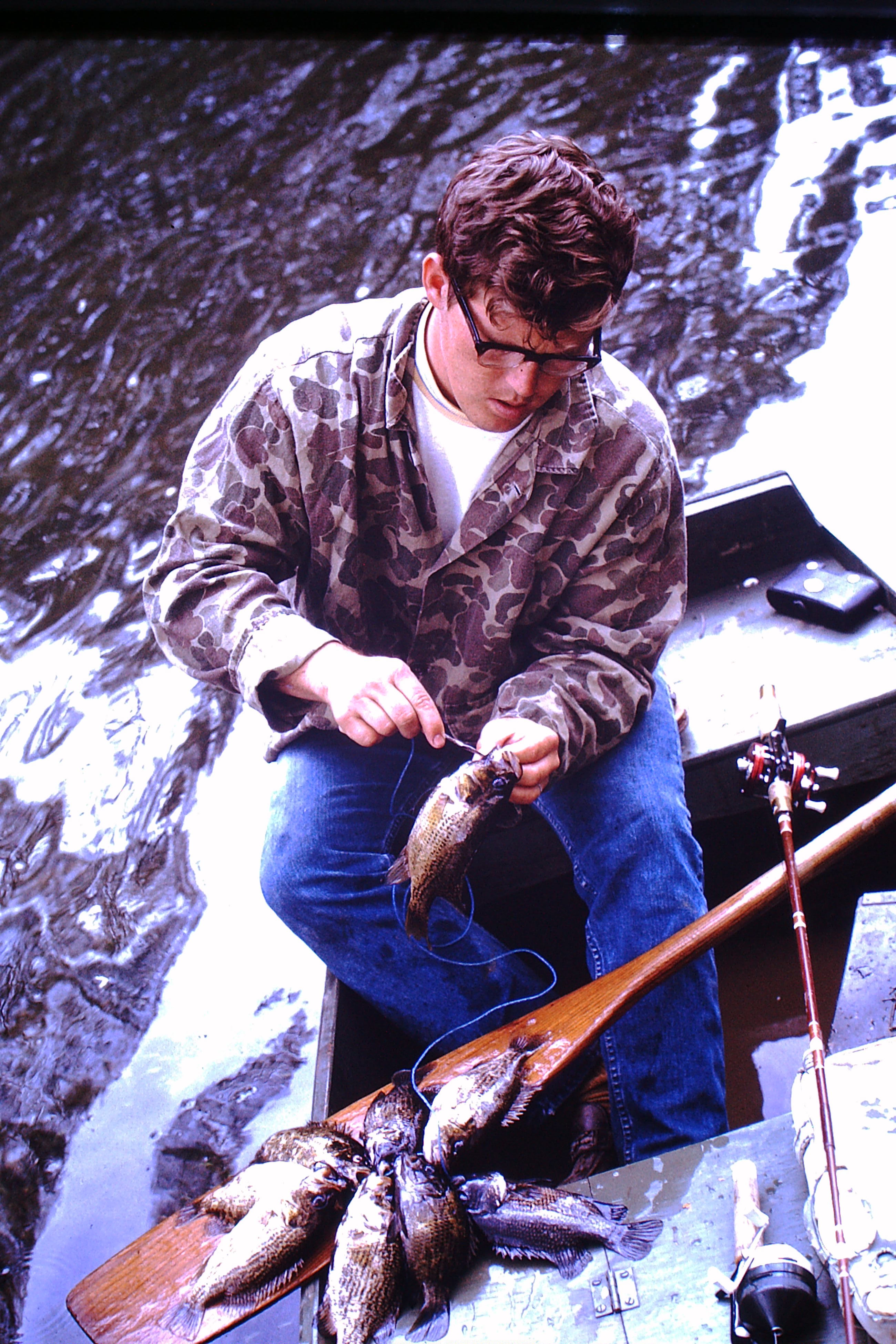
Rock Bass


         Rock bass are to Ozark flowing streams what crappie are to reservoirs. Creel census figures show that they make up the largest percentage of fish caught and fish kept by stream fishermen in the Ozarks. Missouri fisheries people once kept track of the fish coming out of the Big Piney, Current, Niangua, Huzzah, and Courtois, and they figured goggle-eye made up 25 to 35 percent of the fish caught and kept. It is likely they overlooked the green sunfish caught when they did that survey. Green Sunfish most likely are caught at a very high rate, but not kept often. Biologists from that long-age time also did a study of growth rates, which showed that rock bass on the Black and Jacks Fork Rivers were three years old when they reached six inches in length. But at Bennett Springs, next to the Niangua River, they were six inches long at two years. Three-year-old goggle-eye there were about eight inches long. Eleven-inch fish (a real rarity even then) from the same waters were seven years old. 


         The record rock bass was 17-inches long, caught in Ontario Canada, and it weighed 3 pounds. I know of a two-pound, 15-inch rock bass taken from the Big Piney River right at the mouth of Hog Creek back in the early ‘60s. My Uncle Norten was fishing just after dark in a deep hole with a jitterbug, trying to catch a big smallmouth. That huge rock bass, which he landed, was the only one I ever knew to hit a jitterbug at night. In hours and hours of summer night fishing with a jitterbug on several streams in southern Missouri and northern Arkansas, I have never caught a rock bass that way. And truthfully I have caught very few of them on topwater lures in the daytime. They are an underwater-feeding type of fish, although on occasion you may catch them in a foot and a half of water in April and May.


        One year in the 1980’s, I fished Arkansas’ Crooked Creek often, and that small stream between Harrison and the White River below Yellville was chock-full of rock bass. You could fish all day and catch a boatload of smallmouth on topwater rebels at certain times of the spring and summer, and never catch a rock bass. Switch to a small beetle-spin or grub and bounce it along the bottom, and you’d find out there are as many rock bass as there are smallmouth. But that was a different time. Much of those waters are filled in today.


         When I was a boy and Dad and I floated the Big Piney and Little Piney Rivers in the spring and summer, we had the best lure I’ve ever seen for goggle-eye. A man named Art Varner from Salem, Missouri, made a small spinnerbait called a shimmy fly. These lures, one 3-eighth and one-fourth ounce, had lead heads and honeybee yellow and black or yellow and brown bodies, with brown or black squirrel hair tied over them. The small offset spinner rode just above the body, and we’d dress this up with a split white pork rind fly strip. Fished slowly along the bottom, shimmy flies got hung up often, but picked up rock bass, green sunfish, and smallmouth like nothing I’ve ever used. Mr. Varner died in the late ‘60s, and within a year or so, shimmy flies were no longer available. But about that time beetle spins began to appear, and now there are a variety of plastic lures on the same type of spinners, which are very effective for rock bass.

Piney River goggle-eye


         The rock bass does indeed love rocks,. But some of the best fishing I’ve had with minnows and night crawlers has been around large root wads of fallen trees washed into deep water any time of the year, any time of the day. They love a big submerged root wad just as much as a big rock.


         I seldom fish for them today, as upper reaches of Ozark stream have become shallow and the rocks I once fished are becoming covered with silt and gravel. Progress… land clearing and erosion! But last spring I made a trip on the lower Big Piney with old-time riverman and fishing guide Charlie Curran, and we found lots of goggle-eye to be caught on small rubber grubs fished slowly close to the bottom in deeper water. But 80 percent were less than 8 inches. In most streams where rocks are found in deeper water not yet filled in, Ozark goggle-eye can thrive, IF fishermen will abide by that 8-inch rule. They have gone through hard times, but anglers willing to return all smallmouth, and return any rock bass under 8 inches, can play a big role in keeping rivers something like they were in that time long ago when only wooden johnboats drifted downstream, in the pursuit of brownies, goggle-eye and black perch!


Thursday, April 27, 2023

Grabbing Buffalos


This fisherman intends to have buffalo ribs for supper.  


         I love the outdoor life I live because all day long when I am on the river or exploring the woods, I see spectacular things that remind me that God is still in charge somewhere, though those places grow fewer nowadays.  


         All day long I see no one, and there is no television or smart phones or news.  It could be 1840 if you can forget that there is a California or Chicago or New York, and about the only place you can forget those conflagrations of men and women at their worst is off in the wild someplace.


         Floating the river a day or so back, I saw some huge black buffalo getting ready to spawn below shoals where they will mass in great swarms in three feet of flowing water. They are unlike other suckers in that they are very dark, when you see them beneath your boat. They are not related to the carp, which is an introduced, not-native fish.  


         As a kid on the Piney River I grabbed a lot of suckers; yeller suckers and some redhorse suckers too, none ever much bigger than three pounds.  But this week or next I will go down to one of those shoals and grab some black buffalo fish that, if I am lucky, will weigh ten pounds or better.  I never caught one that big, but you see lots of ‘em there.  There will be bigger ones on that shoal.  Few will weigh less than 5 pounds and a few will go up to 15 pounds.


         Some specimens of the black buffalo have been known to weigh 50 pounds but I have never seen one above 15.  Last year I snagged one that was about 7 pounds and I thought he was bigger because it like to wore me out. I use 18-pound line and casting gear, with a great big treble hook and a piece of white rag tied about two feet in front of that hook.  When a fish swims over the white rag you jerk like the dickens and hope your hook hits home. The fish will give you a fight like you haven’t often had, using that swift current. You won’t land all you hook, but if you can net a couple or three you can have some good eating; just look for the recipe for Buffalo Ribs in some old fashioned cook book.  Folks in Arkansas and Louisiana say there isn’t a catfish filet anywhere that will equal fried buffalo ribs.  I have never tried them, but they are bragged on too often not to be great eating. 


           Anyway if I succeed, as I expect to do, I will send a picture next week of me holding up a black buffalo, grinning and happy, as I usually am when off somewhere far from concrete, pavement, and those poor folks who have to go to work each day. I’m happy even if I don’t have a big fish to hold up and grin about, if I am where there isn’t another soul but me. 


         Right now there are big gar on a shallow shoal so thick their backs stick up out of water.  They are not native to small Ozark streams. They are native to the Missouri and Mississippi rivers and somehow, about 100 years ago began moving up into flooded small Ozark streams, and reproducing there. Some more diversity, which is always disastrous in nature too! I have been told that gar are relatively good to eat but I have never tried one. “Ain’t gunna neither” as the old fisherman in the pool hall would say. I’d druther eat a mud puppy!  I hate gars! Never ate one because I never did fancy using a chain saw to skin a fish! Gar too can get up to about 50 pounds in the big rivers and lakes, and are said to be remnants of the prehistoric age. They are the ugliest of fish, and a detriment to any Ozark stream where they are found.


         You can find out more about both species on the computer, but the black buffalo are not nearly as dark in the photos I have seen as they are where I will be snagging them.  Check out my blogspot , (www.larrydablemontoutdoors) to see some great photos of migrating teal I shot this past week.  And if you want to get a copy of my new magazine, just contact me.  The spring issue is available now, 112 color pages on the outdoors and the Ozarks.


Photos of Spring-plumage blue wing teal resting in the Ozarks on their migration north.


Monday, April 17, 2023

TURKEYS AND MUSHROOMS


There comes a time when they get fewer and fewer that you have to stop killing them.  That time is now.


        I have decided that turkey hunting and life in general have a great number of similarities.  For instance, sometimes in life, striving for the goal is more enjoyable than reaching it and accomplishing it.  When you have pulled the trigger and the great bird is down, flopping around in his death throes, don’t you feel a little bit of sadness down deep inside?  Don’t you wish he had been a little slower and gobbled a lot more and strutted longer in the direct beams of the early morning sun?


         See, it’s a lot the same way you feel when you’ve finally bought that new pickup you always wanted and you drive it home and you know it’s going to be a mess in a month with a dent in the bumper.  Driving it out of the driveway at home will never be as great as it was driving it off the dealer’s lot.  It’s much the same way you feel when you’ve been married a year and suddenly you see your wife in curlers and an old robe and you realize she looks a lot like her mother.  If she would have agreed to marry you on the first date, you’d have missed all the enjoyment of being told “no” so often.


         A dead gobbler isn’t the reward of the hunt.  He is the reason for it, but he isn’t the reward.  If you don’t understand what I’m talking about, you might be greenhorn.  But it’ll come to you someday.


         Life is a series of rare successes, great and small, occurring between numerous failures.  That’s what turkey hunting is.  If you hunt turkeys, you can deal with life’s failures, because you know there will be another gobbler, another day.  You know that the wind and the rain and the cold only goes on so long and eventually you are going to have that beautiful spring day when it is calm and sunny and warm, and some gobbler just can’t stop gobbling.  


         You know that one time or another each season, there’s going to be one that comes like he’s on a string, like he hasn’t seen a hen since the end of last summer.  And that’s when you forget that there have been a dozen or so that got spooked, went the wrong way, found a hen, or put food above romance.


Turkey hunting has taught me to be patient and persevere and be thankful for every minute whether the sun is warm or the rain is cold.  Turkey hunting has taught me that sooner or later, every hog finds an acorn, every novice learns the ropes, every hard-luck-Harry gets a break.  You just don’t quit.  But in time, the reward isn’t just a dead turkey, it’s the trying and the failing and trying again, knowing if you don’t quit, you’ll have your time.


         You can find treasure in the difficulties, and you can have a great life just finding occasional rewards here and there amongst the failure.  Just don’t ever forget, in your day-to-day life, that quite often, the turkeys win.  That’s the way it oughta be!


         But as difficult as times have been for the wild turkey, hunters like me should start thinking about no longer hunt gobblers with a gun.  Gobblers in most regions of the state are declining badly.  In some spots they are down only 40 or 50 percent, but in some areas they are down 60 or 70 percent.  It is time to stop hunting them, because if we do not, it will be worse next spring.  If you want to keep shooting them, use a camera, as I do now.  The ineptness and greed of our game departments will not bring them back, we hunters have to do it.  Join me and some other old-time hunters in saying… ‘not this spring!’


         Is it true that the Missouri Department of Conservation gives 100 thousand dollars each year to the National Wild Turkey Federation?  I understand that they have done that for many, many years, and the money is wasted.   The NWTF has done nothing for wild turkeys in  Missouri, nor anywhere else for that matter.  It is another one of those organizations where money pours into the pockets of a few and pays for vehicles and equipment used for private use. 


It was the NWTF that came up with the idea of “scoring” turkeys, where you could get so many points for the length of beard, length of spurs, number of beards, weight, number of teeth and that kind of thing. If your point total got high enough, you could get in their record book and get a patch and become famous.


Shortly after the scoring system was developed, several of the NWTF’s higher-up officers were arrested in western Missouri for baiting turkeys and taking more than the legal limit. They confessed that they had been feeding the gobblers corn because they were trying to kill a really big, long bearded gobbler and get in that NWTF record book.


I have been told it is a good thing that I never did drink or smoke because I have exhibited addictive behavior, concerning eating and hunting and fishing.  I notice that when I get to hunting mushrooms I forget where I am and where I am going.  I have scratches on my forehead from running into tree limbs, and I left a good turkey call somewhere out there in the woods where I came across a pretty good grove of mushrooms.  There was one tree that had about fifteen nice big morels around it just recently and if I knew where it was, I’d know where that turkey call was. Glad I didn’t leave my camera with it!


                             A new way to hunt wild turkeys

A good friend, Clyde Troutt, who taught me to hunt turkey with a gun and camera